

-
Research Article
-
Generative AI and Sociocultural Theory: A Theoretical Reinterpretation for Foreign Language Education
생성형 AI와 사회문화이론: 외국어교육에서의 이론적 재해석
-
Koo, Yuson
구유선
- Generative artificial intelligence (AI) has rapidly emerged as a transformative tool in foreign language education, yet its educational role has often been …
- Generative artificial intelligence (AI) has rapidly emerged as a transformative tool in foreign language education, yet its educational role has often been discussed without a coherent theoretical foundation. This paper reinterprets generative AI through the lens of Vygotsky’s Sociocultural Theory (SCT) by examining its relationship to key concepts, including mediation, cultural tools, the Zone of Proximal Development (ZPD), scaffolding, the More Knowledgeable Other (MKO), and self-regulation. Drawing on recent literature in AI-assisted language learning and SCT, this study argues that generative AI is best understood not as a replacement for teachers or an independent instructional agent, but as a mediational cultural tool that supports learners’ cognitive development and self-regulated learning through socially situated interaction. By providing a sociocultural reinterpretation of generative AI, this study offers a theoretical framework for understanding AI-mediated language learning and suggests directions for future research and pedagogical practice. - COLLAPSE
-
Generative AI and Sociocultural Theory: A Theoretical Reinterpretation for Foreign Language Education
-
Research Article
-
A Study of English Learner Identity Among First-Year University Students
대학 신입생의 영어학습자 정체성 연구
-
Ha, Myeong-Ae
하명애
- This study aimed to explore how first-year university students construct and reconstruct their English learner identities during their transition from secondary school …
- This study aimed to explore how first-year university students construct and reconstruct their English learner identities during their transition from secondary school to university. Three first-year university students enrolled in general English courses participated in the study. Data were collected through semi-structured interviews, reflective essays, and classroom field notes and were analyzed using thematic analysis. The findings revealed that participants initially developed negative English learner identities through secondary English learning experiences centered on the Korean college entrance examination. After entering university, they redefined English as a resource for academic study and future career development. Their imagined communities in future professionals increased their investment in English learning, while supportive interactions with the professor and peers promoted classroom participation, confidence, and more positive English learner identities. The findings highlight the importance of fostering future-oriented English learner identities and promoting sustained investment in language learning in university English education. - COLLAPSE
-
A Study of English Learner Identity Among First-Year University Students
-
Research Article
-
A Corpus-Based Study of Lexical Diversity, Lexical Difficulty, and Delexical Verb Collocations in the Listening Tests of CSAT, TOEIC, TOEFL, and IELTS
CSAT, TOEIC, TOEFL, IELTS 듣기 시험의 어휘 다양성과 어휘 난이도, 탈어휘 동사 연어의 코퍼스 기반 연구
-
Han, Younghun, Lee, Heechul, Shim, Jaewoo
한영훈, 이희철, 심재우
- This corpus-based study compares the lexical and collocational characteristics of listening scripts from CSAT, TOEIC, TOEFL, and IELTS, identifying distinct linguistic patterns …
- This corpus-based study compares the lexical and collocational characteristics of listening scripts from CSAT, TOEIC, TOEFL, and IELTS, identifying distinct linguistic patterns associated with each test’s purpose. Findings reveal that IELTS exhibits the highest lexical diversity and lexical sophistication, whereas TOEIC shows high short-range variation reflecting frequent business-topic shifts. CSAT primarily utilizes basic vocabulary, while TOEFL displays strong topic concentration within academic domains. Furthermore, delexical verb collocations reflect specific discourse domains: TOEIC emphasizes workplace expressions, TOEFL highlights academic patterns, and CSAT features everyday phrases. Overall, each test exhibits a distinct lexical and collocational composition that reflects its target domain and the specific communicative demands of secondary education, business, and higher education. - COLLAPSE
-
A Corpus-Based Study of Lexical Diversity, Lexical Difficulty, and Delexical Verb Collocations in the Listening Tests of CSAT, TOEIC, TOEFL, and IELTS
-
Research Article
- Pseudo-Incorporation and Semantic Incorporation in Japanese: A Multi-Mechanism Account
- Kitaoka, Daiho
- This paper investigates incorporation-related phenomena in Japanese, focusing on the distinction between pseudo-incorporation and semantic incorporation. I argue that the diagnostics associated …
- This paper investigates incorporation-related phenomena in Japanese, focusing on the distinction between pseudo-incorporation and semantic incorporation. I argue that the diagnostics associated with incorporation should be distinguished according to whether they target morphosyntactic integration or semantic interpretation. Miyagawa-type caseless noun–predicate sequences exhibit properties compatible with phrasal pseudo-incorporation, including case reduction, phrasal complexity, and structural proximity to the predicate. However, their acceptability is variable among contemporary speakers, and the present observations do not conclusively distinguish pseudo-incorporation from a restricted compounding analysis. Ordinary case-marked bare nouns, by contrast, remain morphosyntactically independent. Under narrow-scope interpretations, however, they display a cluster of properties associated with semantic incorporation, including number neutrality, non-specificity, restricted referentiality, and compatibility with atelic interpretations. These properties motivate a semantic incorporation analysis, although alternative semantic accounts are not excluded. Wide-scope bare nouns provide a secondary contrast and appear to involve higher nominal structure, but their fuller analysis lies beyond the scope of this paper. The findings therefore suggest that incorporation in Japanese is grammatically heterogeneous and that morphosyntactic and semantic diagnostics should not be treated as a single undifferentiated set. The analysis is intended as a preliminary step toward a more differentiated account of incorporation-related phenomena in Japanese. - COLLAPSE
-
Research Article
- Learner Perceptions of Gamification and EdTech in Language Learning
- Woo, Sujung
- This study examines how Nepalese university students at a Korean university view gamified educational technology (EdTech) tools for learning Korean across three …
- This study examines how Nepalese university students at a Korean university view gamified educational technology (EdTech) tools for learning Korean across three cohorts defined by length of study. An explanatory sequential mixed-methods design was employed. A survey (N = 100), built on an integrated UTAUT2-TAM framework drawing on UTAUT2 (Venkatesh et al., 2012) and TAM (Davis, 1989), was followed by three group interviews with eight participants in total. Kruskal-Wallis tests found no significant cohort difference in behavioral intention, H(2) = 3.44, p = .179, ε² = .035, but significant differences in effort expectancy, H(2) = 9.06, p = .011, ε² = .091, social influence, H(2) = 6.91, p = .032, ε² = .070, and hedonic motivation, H(2) = 6.71, p = .035, ε² = .068, with the newest cohort scoring higher than the most experienced. The interviews do more than restate this pattern: they indicate that the divergence reflects a shift in the tools’ functional role, not a decline in regard for them—cohorts with access to classes treat them as supplements, while the most experienced cohort, which lacked formal Korean coursework, relies on them daily out of necessity, and this sustained, obligatory reliance exposes the tools’ limits even as intention persists. Implications for universities that host international students are discussed. - COLLAPSE

Journal Informaiton
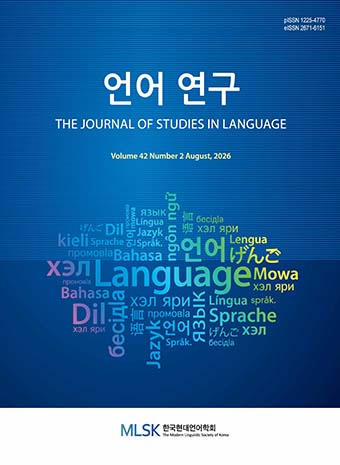 The Journal of Studies in Language
The Journal of Studies in Language






 The Modern Linguistic Society of Korea
한국현대언어학회
Daejeon University, 62, Daehak-ro, Dong-gu, Daejeon, Republic of Korea
Tel: +82-42-280-2302 / E-mail: mlsk_1984@naver.com Copyright© The Modern Linguistic Society of Korea. Powered by APUB
Tel: +82-42-280-2302 / E-mail: mlsk_1984@naver.com Copyright© The Modern Linguistic Society of Korea. Powered by APUB